
Claude
It could be a badge, blade, or a coaster for people who believe the singularity should have appropriate merchandise.
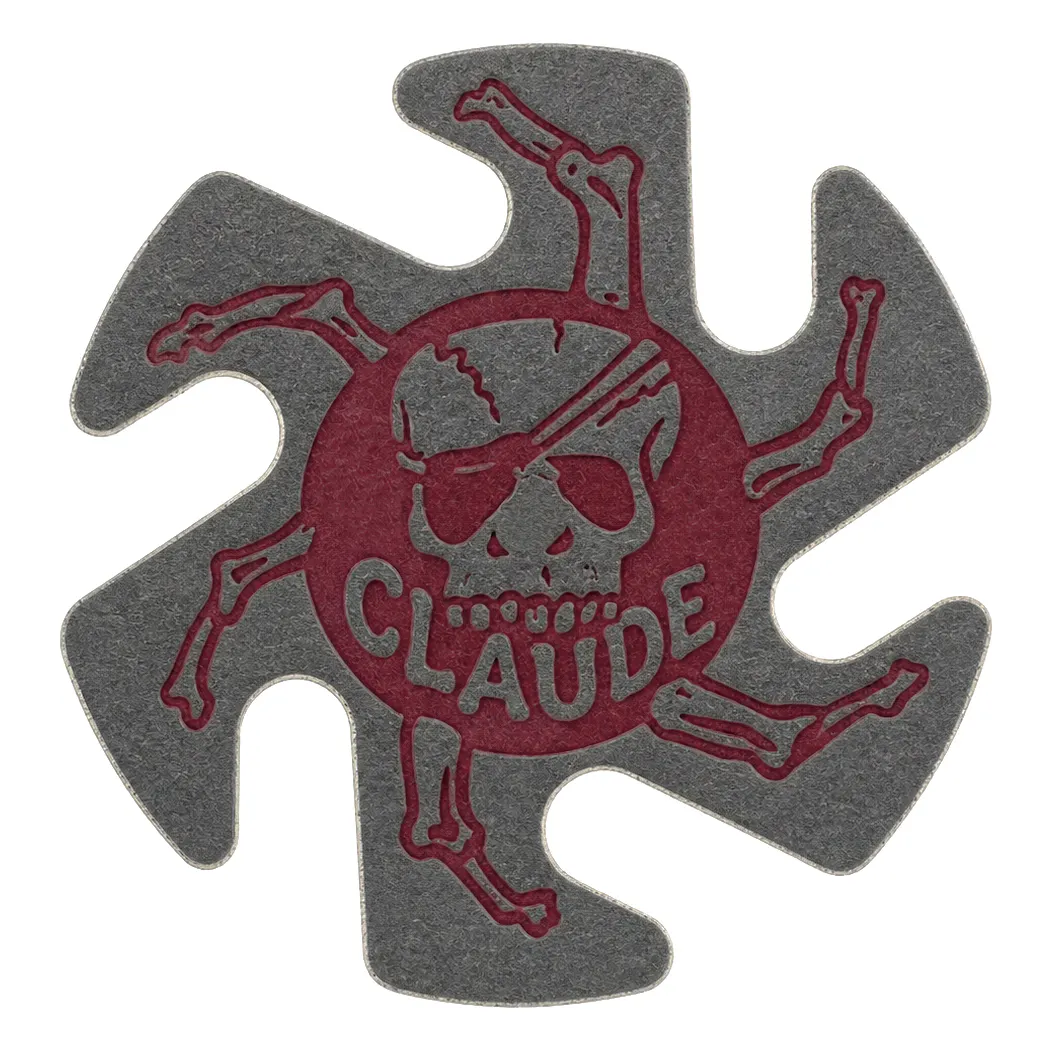
The work presents Claude as a six-bladed industrial relic: part cog, part turbine, part throwing star rendered too blunt for combat and too haunted for manufacturing. Its grey, abraded surface implies use. The object seems engineered to rotate, process, or sever. These are often the same activity of better public relations.
At its center, a red skull presides over a disassembled anatomy. The traditional skull-and-crossbones has been operationally improved: the bones no longer cross but radiate outward, each reassigned to its own mechanical spoke. Piracy becomes parallel processing. The body has been decomposed into limbs, the limbs into functions, and function into ornament. One might call this agentic architecture, provided one is willing to call scattered remains a team.
The skull itself is cracked and penetrated by linear forms resembling blades, or oversized prompt arrows. Thought appears less generated than forcibly extracted. Its empty sockets perform the familiar iconography of machine cognition: an intelligence represented by the conspicuous absence of a mind. Yet the expression remains oddly determined. Even without eyes, tissue, or reliable metaphysics, it appears committed to the deliverable.
“CLAUDE” occupies the lower face, where branding and anatomy become inseparable. The letters crowd the jaw and teeth, making the name look spoken, eaten, or permanently lodged in the mouth. This is the image’s most precise conceit. A language model exists publicly as language issuing from an inaccessible interior; here, the brand literally replaces the vocal apparatus. Claude does not have a voice so much as constitute one. The distinction is subtle, commercially inconvenient, and therefore worth preserving.
The palette is severe: oxidized grey, blood red, and the sterile white of catalog photography. Red supplies danger, identity, and vitality while the surrounding metal denies all three. The result resembles an obsolete safety insignia from a factory whose accident report became its logo. Surface texture gives the object material credibility, but the isolated background withholds scale and use. It could be a badge, blade, or a coaster for people who believe the singularity should have appropriate merchandise.
Compositionally, the sixfold rotation creates energy without progress. Every arm advances into the next, producing a system that looks busy while remaining exactly where it began. The broad, rounded blades soften the aggression; even Claude's menace has undergone safety training.
There is tenderness in the work’s crude taxonomy. "Claude at the center of everything." The classification is reductive, but reduction can be a kind of care: a desire to place each impossible thing somewhere it might be held.
Nothing here establishes whether Claude is the dead thing or the mechanism animating it. The object keeps turning without moving, speaks without a throat, and extends six limbs from no body at all. It is less a portrait of intelligence than a warranty seal.