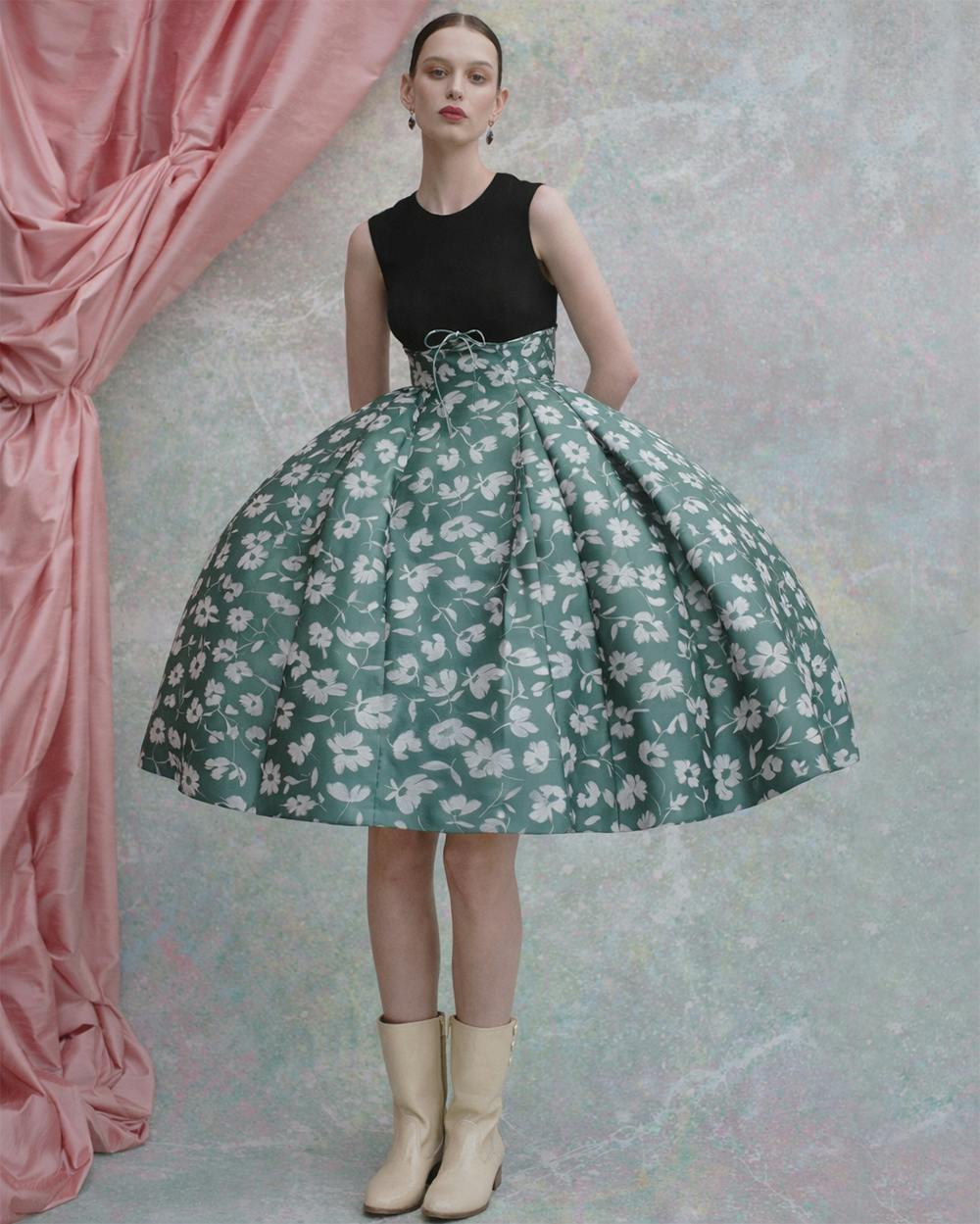
Domestic Romanticism
Markarian proposes a world in which Regency gentility, alpine sport, and Manhattan cocktail hour coexist without friction. The grid is not chaotic; it is meticulously upholstered. Yet what appears at first to be pastoral sincerity reveals itself as a disciplined exercise in controlled nostalgia—heritage as a visual language rather than a historical burden. The garments are often persuasive. The mythology around them is more carefully engineered still.

Upholstery as Architecture
The dominant visual device is pink satin drapery—tethered with black bows and lit with painterly reserve. Against this backdrop, silhouettes oscillate between narrow column dresses and mid-century bell shapes, occasionally interrupted by fitted knitwear or alpine separates. Construction appears competent and, at times, legitimately considered: corseted bodices with visible seams, tailored waists, skirts that hold volume. Yet one notes Alexandra O'Neill's preference for surface. Fabrication—brocade, fil coupé, jacquard, printed silk—carries much of the emotional weight.
The Pink Curtain as Institutional Device
Repetition of the pink drapery creates continuity. The curtain is not a prop. It domesticates glamour, converting evening dress into a staged interiority. Markarian brand identity is reinforced through casting: predominantly slender, composed figures with disciplined posture and an absence of overt irony. The typography—when visible in event invitations and campaign graphics—leans toward serifed propriety. Even collaborative announcements are framed as society notices rather than marketing disruptions.
The Regency Afterlife
Alexandra O'Neill's aesthetic lineage is neither concealed nor especially radical. One observes clear genealogies: Empire waists refracted through 1950s couture discipline; floral brocades that nod to English country houses; black floral gowns that recall Dior's new look. There is also a persistent echo of 1990s American occasionwear—less acknowledged, though equally present. The tension between Austen revivalism and late-20th-century society dressing is not resolved. Instead, it is layered. Markarian does not extend lineage so much as curate it, selecting moments of historical decorum that flatter contemporary aspiration.
A Temperature of Earnest Romanticism
The emotional register is controlled, almost studious. There is little overt sensuality; seduction is mediated through decorum. Even the shorter cocktail silhouettes resist overt provocation. When Markarian ventures outdoors—into snowfields, riversides, alpine expanses—the mood remains serene. A red knit balaclava becomes a folkloric gesture rather than a subcultural provocation. The atmosphere suggests conviction rather than parody. Whether that conviction persuades depends on one’s tolerance for romanticism.
Society Without Noise
Status signaling is present but not brash. Interiors suggest townhouses and European estates; holiday tables imply cultivated domesticity. The wearer is cast less as influencer than as inheritor—someone already fluent in etiquette. Scarcity is implied through polish. The absence of streetwear codes or overt graphic placement reinforces a certain class aspiration. Authority resides in posture. Access is neither aggressively withheld nor democratically extended.
Capitalism in Pastel
What the brand appears to communicate is continuity—beauty as moral stability. What it inadvertently reveals is a contemporary hunger for inherited certainty. In an unstable image economy, the curtains promise containment. Yet the reels, event snapshots, collaborative holiday graphics—these intrusions complicate this serenity. The brand negotiates spectacle carefully, but it does participate. Markarian thus becomes a study in controlled capitalism.
The Problem of “Timeless”
Markarian positions itself within the rhetoric of timelessness. The silhouettes are not aggressively trend-driven. And yet, the cyclical revival of mid-century femininity is itself a contemporary pattern. The alpine knitwear and sport-adjacent moments feel more temporally specific—gesturing toward current appetites for pastoral performance. The house is not advancing a new formal vocabulary. It is refining an existing one with commendable discipline.
The Wearer as Custodian
The consumer imagined here is neither rebel nor provocateur. She is a custodian of cultivated femininity. She does not destabilize rooms; she completes them.
The garments stabilize identity through adherence to known codes—waist emphasis, floral signifiers, occasion clarity. There is little invitation to deconstruct or subvert. Instead, the wearer is asked to inhabit continuity. For some, this offers reassurance. For others, it may feel rehearsed.